Structural drawings engineered to survive review and construction.
Permit-ready calculations, coordinated drawing sets, and disciplined responses to reviewer comments. Sealed deliverables are issued only when jurisdiction-qualified professional engineering coverage and responsible charge are confirmed.
Scope gate
Jurisdiction verified first
Engineering basis
Traceable loads and assumptions
Issue control
Calculation-to-sheet coordination
Sealing protocol
Licensed PE in responsible charge
Permit and reviewer-response packages · Residential, commercial, and industrial scopes · Steel, concrete, timber, and foundations · PE sealing only after jurisdiction confirmation
One accountable package.
The objective is not simply to produce drawings. It is to establish a defensible engineering record that the reviewer, fabricator, contractor, and owner can follow without hidden assumptions.
01 / 06
Design Criteria & Code Basis
Jurisdiction, adopted code, occupancy, risk category, material standards, loading criteria, and project-specific assumptions organized before analysis begins.
02 / 06
Structural Calculations
Gravity and lateral analysis, member design, serviceability checks, foundation reactions, connections, and calculation narratives aligned to the drawing set.
03 / 06
Permit-Ready Drawings
Plans, framing layouts, schedules, sections, details, general notes, and design references formatted for efficient review and field interpretation.
04 / 06
Discipline Coordination
Structural interfaces checked against architectural geometry, equipment demands, penetrations, clearances, fabrication constraints, and construction sequence.
05 / 06
Independent QA Control
Load-path, units, reactions, schedules, references, drawing consistency, and issue status checked through a documented release gate.
06 / 06
Review Comment Resolution
Comments triaged, answered, incorporated, and tracked so the resubmission gives the authority having jurisdiction a clear technical response.
Different structures fail in different ways.
How the engineering package changes for each delivery environment.
01 · Residential / Alterations & New Construction
Clear load paths for homes, additions, and structural modifications.
The package resolves how architectural intent reaches the foundation, with attention to existing conditions, constructability, and the details most likely to trigger plan-review questions.
- Typical systems
- Wood, steel, masonry, concrete
- Critical inputs
- Plans, site, existing conditions
- Primary outcome
- Permit-ready coordinated package
- New residences, additions, renovations, and load-bearing wall modifications
- Foundations, floor and roof framing, lateral systems, decks, and canopies
- Existing-condition constraints and field-verification notes made explicit
02 · Commercial / Multi-Discipline Coordination
Structural packages aligned to architecture, MEP, schedule, and occupancy.
Commercial delivery prioritizes repeatable framing logic, coordinated openings and loads, serviceability, clear schedules, and review evidence that supports a controlled construction release.
- Typical systems
- Steel, concrete, masonry, timber
- Critical inputs
- Architecture, MEP, geotechnical
- Primary outcome
- Coordinated permit and bid set
- Office, retail, warehouse, mixed-use, tenant-improvement, and adaptive-reuse scopes
- Framing plans, lateral systems, foundations, equipment support, and delegated interfaces
- Drawing and model coordination focused on reducing RFIs and field rework
03 · Industrial / Equipment & Process Interfaces
Structures engineered around operating loads and fabrication reality.
Industrial projects connect equipment, process, access, maintenance, vibration, dynamic loads, platforms, and foundations. The package keeps these interfaces visible and traceable.
- Typical systems
- Structural steel, concrete, grating
- Critical inputs
- Equipment loads, process, site data
- Primary outcome
- Fabrication and construction evidence
- Equipment platforms, mezzanines, supports, access structures, and industrial foundations
- Static, dynamic, vibration, fatigue, wind, and seismic demands as applicable
- Connection, fabrication, installation, and operating-clearance coordination
Five gates between intake and issue.
Each gate closes a different category of risk. Work advances only when the required information and engineering decisions are sufficiently controlled.
Gate 01
Jurisdiction & Scope
Confirm authority, applicable codes, project boundaries, sealing needs, schedule, and licensed coverage.
Gate 02
Input Audit
Review geometry, loads, site information, existing conditions, geotechnical data, and missing decisions.
Gate 03
Analysis & Design
Establish load paths, model behavior, size systems, check serviceability, and resolve interfaces.
Gate 04
Documentation & QA
Coordinate calculations with sheets, run structured checks, and close comments before issue.
Gate 05
PE Review & Issue
Complete responsible-charge review, authorize revisions, and issue sealed work where eligibility is confirmed.
The drawing and the calculation must tell the same story.
Our QA model checks the engineering chain, not just formatting. Assumptions, reactions, member marks, schedules, details, references, and revision status must remain traceable through issue.
Calculation-to-sheet traceability
Design outputs are mapped to the plans, schedules, details, and notes that communicate them.
Constructability review
Interfaces, access, tolerances, sequencing, and field constraints are examined before they become RFIs.
Controlled issue record
Revision state, comment disposition, authorized changes, and release status remain visible.
Structural release gate
| Jurisdiction and code basis | Verified |
|---|---|
| Gravity load path continuity | Traced |
| Lateral system coordination | Traced |
| Foundation reaction schedule | Matched |
| Detail and callout references | Resolved |
| Responsible-charge release | Controlled |
No rubber stamps.
No borrowed authority.
A professional seal is a statement of responsibility, not a purchasable graphic. Final sealed documents are issued only by an appropriately licensed professional engineer who is competent in the work, exercises responsible charge, reviews the final package, and can direct necessary changes.
Availability is confirmed during project qualification. Where licensed coverage is unavailable, any support is clearly scoped as preliminary engineering, analysis, or drafting and is not represented as construction-ready sealed work.
Inspect the systems behind the promise.
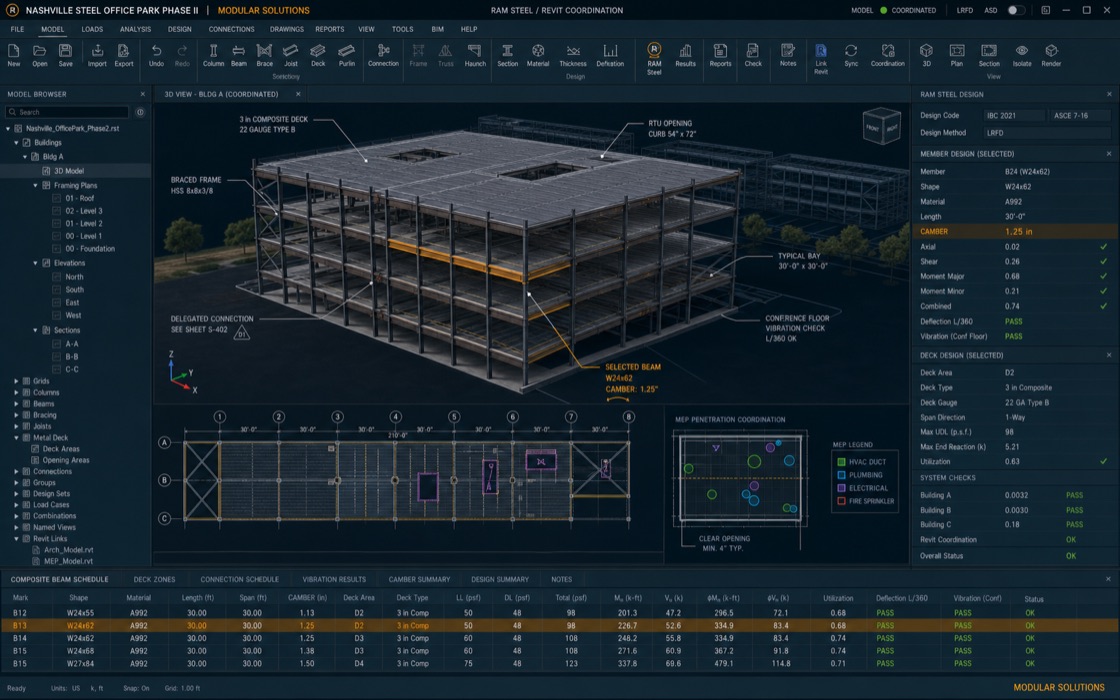
Representative engineering records show the level of analysis, coordination, and documentation used across high-wind, commercial steel, and industrial structures.
Nashville Steel Office Park Phase II
Reduces approval risk, field rework, and load-path uncertainty before capital is committed on site.

Charleston High-Wind Coastal Residence
Reduces approval risk, field rework, and load-path uncertainty before capital is committed on site.
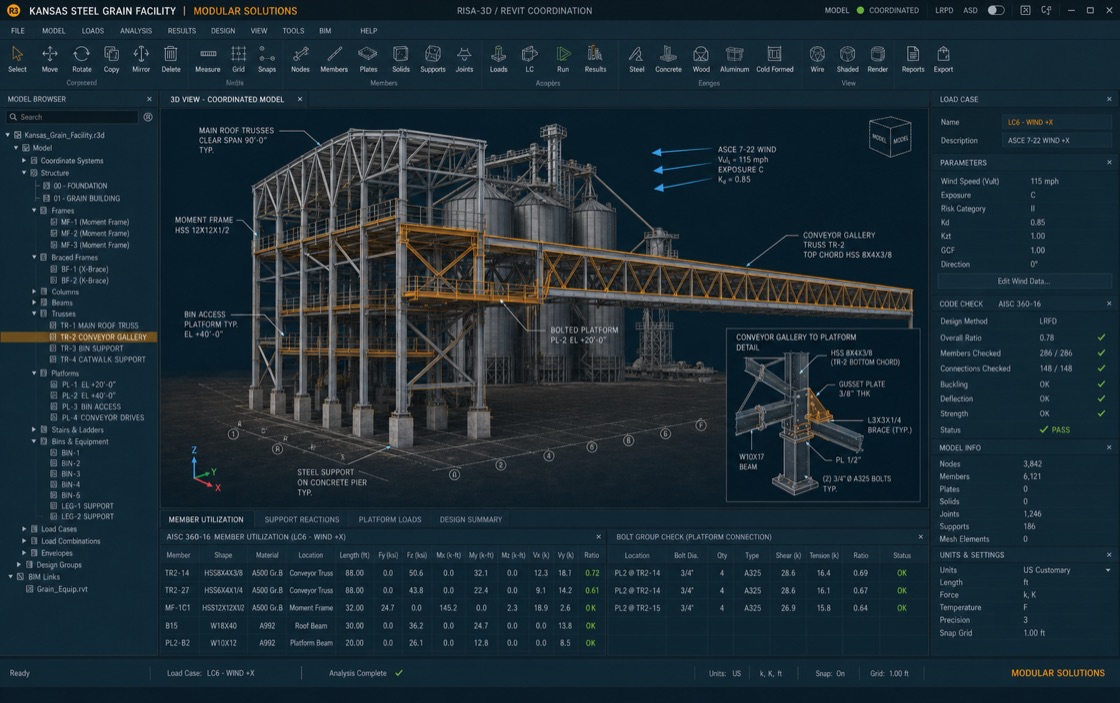
Kansas Steel Grain Facility
Reduces approval risk, field rework, and load-path uncertainty before capital is committed on site.
Questions serious projects ask first.
Can Modular Solutions stamp an existing drawing set?
A professional seal is not a document-review shortcut. Sealed deliverables are issued only when an appropriately licensed PE has responsible charge, can verify the design basis, and can direct any required changes. Existing documents may be used as inputs, but they do not bypass the engineering process.
What is included in a permit-ready package?
The exact package depends on scope and jurisdiction. It may include design criteria, calculations, structural plans, framing layouts, schedules, sections, connection or foundation details, general notes, and formal responses to review comments.
Do you support projects outside one state?
Remote delivery is available. Sealed work is accepted only after confirming the project jurisdiction, applicable codes, scope, and appropriately licensed engineering coverage. This check is completed before a sealing commitment is made.
Can you respond to permit-review comments?
Yes, when the comments fall within the agreed structural scope. Responses are tracked against calculations and drawing revisions so the resubmission forms one coherent technical record.
What information is needed to begin?
Typical inputs include the project address and jurisdiction, architectural or equipment drawings, surveys, existing-condition information, geotechnical data when applicable, intended use, material preferences, schedule, and any reviewer comments already received.
How are fees and delivery dates established?
They are established after reviewing scope, jurisdiction, existing information, complexity, coordination needs, sealing requirements, and schedule. The engagement brief identifies included deliverables, assumptions, client inputs, review cycles, and exclusions before work begins.
Bring the jurisdiction, the drawings, and the real constraint.
We will determine whether the scope fits our structural delivery model, what information is missing, and whether jurisdiction-qualified PE coverage can be confirmed.